
In this blog post, I am going to be talking about the Pineal Gland, also known as the third eye. I am going to be exploring the topic from a biological and mystical point of view in an attempt to find level ground and understanding as to what is the nature and function of the Pineal Gland. Stay tuned till the end, it will be worth it.
What is the Pineal Gland?
The Pineal gland is an endocrine gland found at the midbrain, right at the top of the brainstem. Its primary function is to regulate the body’s sleep-wake cycles and regulate emotional states by secretion of hormones such as melatonin, serotonin and some other neurosteroids.
The Pineal gland acts as a neuroendocrine transmitter, converting light signals from the environment into hormonal signals. It also regulates the body’s circadian rhythm, which directly impacts mental and physical health.
This gland creates hormones and induces them directly into the bloodstream, altering the body’s chemistry at a moment’s notice.
Some hormones that are created by the Pineal gland and secreted into the circulatory and nervous system include:
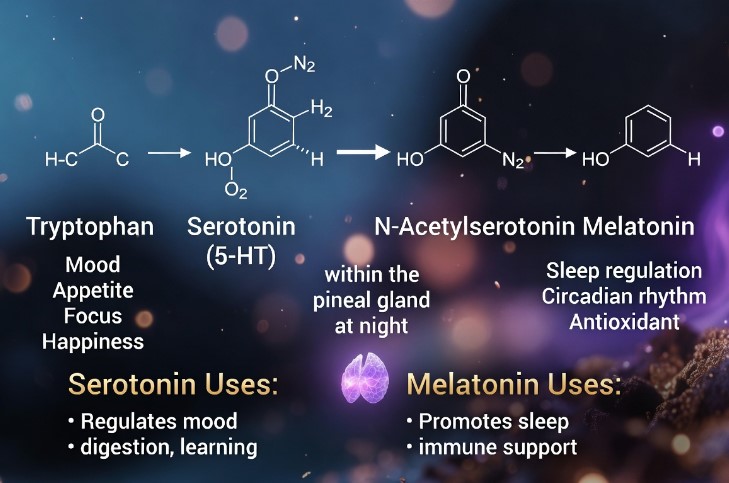
Melatonin
This is a hormone that the body uses to biologically neutralize exhaustion, fatigue, depression, and insomnia when induced as a supplement.
The body produces this hormone in controlled quantities to help balance wake-sleep cycles and mood swings.
Melatonin is often referred to as the “sleep hormone” because it is secreted in darkness, i.e., at night and during sleep.
Serotonin
This hormone functions as a chemical messenger that informs various parts of the body how to function. A neurotransmitter of bioelectrical signals that command motor, cognitive and emotional processes from the brain around the body.
It is involved in the body’s ability to observe, feel emotions and sense mood changes, use cognition, learn and move muscles.
This hormone is referred to as the “happy hormone” as it allows a person to ward off depression, anxiety and mental-emotional fogs.
DMT – Dimethyltryptamine
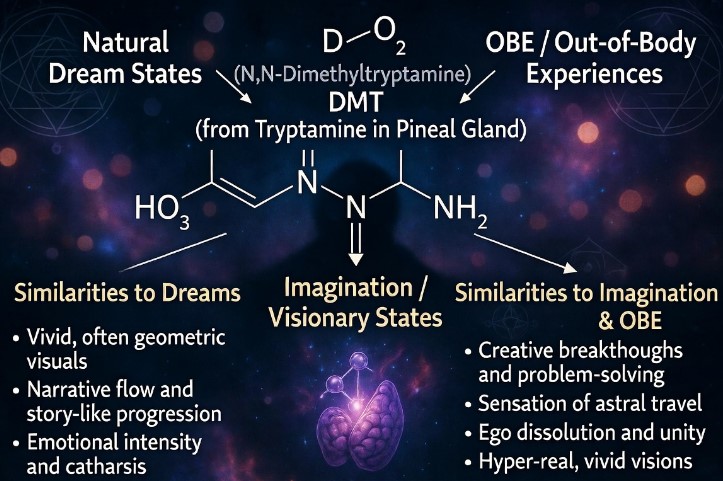
While this is not exactly a hormone, but functions and uses the same circulatory and neural pathways that both melatonin and serotonin use, Dimethyltryptamine, also known as DMT, has faced a lot of controversy in mainstream science as to whether it is being secreted by the pineal gland.
However, there is confirmed evidence that DMT can be produced naturally in small quantities by mammalian brain cells; also, evidence and traces of DMT have been found in cerebral areas and on the Pineal gland.
DMT, also known as the “Spirit molecule,” happens to be a powerful psychedelic substance that, when induced, causes a person to have a reality-altering experience, dissolving the perception of space and time.
People have reported and confirmed experiences in other dimensions with entities far from human. These experiences are happening within this person’s psyche as hallucinations, but appear as real as a dream until you wake up.
The effects of DMT are intense yet fleeting; people have confirmed out-of-body experiences that tally with reports of near-death experiences, not just in visuals but also biologically whenever spikes of DMT are found in both individuals who were studied.
The Pineal Gland and Mysticism
We have to take a peek at the pineal gland from a scientific point of view, which looks at things via biological observation, dissecting physically from the outside going in. Let us take a closer look at the mystical relevance of the pineal gland, observing from the inside via sensory and physiological observation from the inside going out.
Here the pineal gland is known by another name, the “third eye” which according to the mystics is built like an actual eye but instead of seeing physical light and matter, it sees in terms of energy, using the 6th sense instead of sight know what happens around and within the body, no doubt paying attention to all the neurological signals that transpire through the nervous system to the brain.
The pineal gland’s position at the brainstem grants it full access to the nervous system’s information; it is, after all, the gland of emotional and sensory regulation. This means it can “see” energy moving through the body, directly confirming the mystics’ view of the “eye” able to look and see within the body.
How The Third Eye Looks Within
This curious faculty also allows the third eye to see the etheric field as well as the auric field around a human being. The auric field, also known as the tordic field, scientifically is a cloud of electromagnetic energy around a person’s body due to the activities (beating) of the human heart. This electromagnetic field animates the human organism and keeps the heart beating.
The etheric field is all the space in which all matter exists, but also the energy that exists through lifeless things. Think of the ether as water, the etheric field is the ocean, and the things found in the ocean, i.e., fish and coral – those are planets, stars and asteroids. Space is the etheric field.
With proper awareness cultivation with one’s attention at the area of the third eye, i.e. where pineal gland, is located between the eyebrows, one is able to train and evolve the 6th sense of having extra sensory and perceptive abilities with psychic abilities with precision, akin to the physical eye.
One can see (vibrationally pick up subtle energy) energy like anxiety, fear and despair clearly, and by “see” here I actually mean sensing emotional states, seeing with the mind’s eye is quite similar to seeing with the physical. Allow me to guide you on a quick practice to align us on the same page as to what and how the third eye sees.
- Step 1: Close your eyes
- Step 2: Use and imaginary pen and write your name on the black on the back of your closed eyelid.
Did you see anything? No. But you felt it, sensed it, keep writing your name in the dark shadow behind your eyes, notice that your brain is still able to sense what is being written.
The Third Eye and The World beyond the Physical
Similar to when someone writes something with their finger on your skin, you can sense what is written, but now it is being written on your mind, hence the term “the mind’s eye” is associated with the third eye, the eye that sees imagination, memories, thoughts and dreams.
So next time you notice your emotional state shift after talking to a person or just standing next to them, that’s your third eye working, noticing subtle energy shifts with the 6th sense, making sense?
Cool.
The third eye, with proper awareness cultivation, can sharpen the sixth sense to the point where the person awakens and develops the following innate abilities:
- Sense and know the emotional state of a person, group, or place just by standing in proximity of that person or place, with advanced awareness. This can be done with thought alone; one will not need to be physically present, just thinking of said person or thing.
- Pick up on the thoughts of a person telepathically by thinking of them intentionally. Please note that a connection like this is open-ended; this means your thoughts are accessible to the person you are connecting to. It goes both ways if the other person has heightened awareness.
- Be able to sense and know when a person is about to call or walk into the room.
- Sense a person is looking at them, only to look up and catch the person indeed looking at them, sensing what someone will say moments before they say it.
- See in vision, flashes or dreams things that will happen, days, weeks or months before they happen, exactly as seen, often accompanied by feelings of deja vu.
- See and experience consciousness when the physical body is unconscious or in a subconscious state, like astral projection, remote viewing, out-of-body experiences, etc.
Different levels of extra-sensory abilities for different levels and intensities of your awareness cultivation practice, with attention anchored at the third eye/pineal gland.
One begins to understand why yogis and monks spend hours to days atop mountains and in temples chanting “AUM” or “OM” with their attention on their third eye, often adding a symbol on the forehead to further anchor their attention and ground the idea.
With all the following taken into consideration, the pineal gland is not just an endocrine gland that regulates sleep and mood, but a gland that can be trained to be used for observation, discernment, and assimilation of subtle bio-electric and neurological signals travelling within and outside the body.
It is a gland that sees and regulates emotions, and emotion is simply energy in motion, bioelectric charges running through the body as a phenomenon known as emotional states. This is the part of the human organism directly associated with emotional and intellectual intelligence.