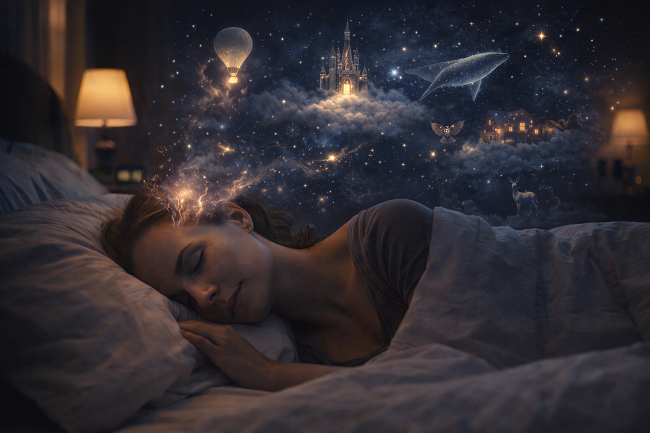
In this blog post, I will be exploring the nature of dreams, what dreams are, where they come from, and the various kinds of dreams, all in an attempt to debunk the idea that dreams are strange fantasy worlds separate from waking life, but rather our consciousness continuing its work in another environment with fewer limits and filters.
What is a Dream?
A dream is a series of images, visuals, events, and feelings that happen within the mind while a person is asleep.
Dreams have always fascinated mankind ever since the beginning of time, from biblical stories of kings receiving warnings and guidance in their dreams, all the way to shamans able to tell a person’s destiny and fortune from their dreams.
Dreams have also become the highlight of pop culture, heavily influencing dozens of Hollywood productions and even catching the attention of intelligence agencies who have tried to harness the power of dreams for espionage and military purposes.
But what’s interesting is that when you ask a random person, “Where do dreams come from?”, you’d most likely get an “I don’t know” for an answer. Why is there so much mystery around the concept of dreaming?

What Happens to the Mind When We Dream?
In order to fully understand what happens in the mind when we are dreaming, I feel it’s best to start with what happens in the mind when we are fully awake.
When a person is awake, the brain and the mind operate in a state called the Beta Brainwave state, which is characterised by an active, logical, and analytical mind. A person who is in this state will experience relatively clear thoughts that come from frontal lobe activity.
The person is alert and is able to interact with their environment, and within the mind, the inner monologue is online and is doing an analysis and sorting of all that they see and feel. You may indulge it and experience what we call “being lost in thought”.
This lost-in-thought experience, however, transcends the Beta state into what is known as the Alpha state. When a person is relaxed Alpha brainwave state is a sleepy or drowsy state of being, where a person is fully awake but not for long. The person in this state will most likely be reluctant to move. This is a meditative-like state, where most access is gained while falling asleep or lost in thought.

“Photo by Idzard Schiphof on Unsplash
.”
When a person is awake, so is the conscious mind, which filters all that we experience, crunching numbers and making sense of it all. The conscious mind is fully committed to this task and will do this to the point where it exhausts the thinker if left unchecked. This is where sleep and dreaming come into play.
When we start falling asleep, the mind’s awareness slips from the conscious towards the subconscious mind as we transition from Beta to Alpha. In simple terms, the logical control quiets down while imagination and subconscious activity become dominant. Allowing the mind to think freely without the logic getting in the way of what’s reasonable and what’s not.
Hence, day-dreaming feels better than regular thinking because of the state that the brain is operating in Alpha, which has more emotional sensory than Beta.

“Photo by Daniele Franchi on Unsplash
.”
Why Dreams Feel So Real
Dreams feel so real because the brain and nervous system respond to dreams as if they are happening now,
which is why dreams can change mood, memory, and emotional state.
Just like regular thinking, which also causes change in mood, memory, and emotional states. So what’s going on here is quite simple. The mind is still doing its thing regardless of what state your brain is in. These brainwave states are more like filters that shape your perception of reality based on your state of consciousness.
As a person transitions from fully awake (beta); where the analytical conscious mind is active, to being sleepy (alpha) where the subconscious mind bypasses the conscious, causing the mind to quite down allowing feelings to influence the mind as opposed to the other way around, and finally falling asleep (delta – gamma) where the subconcious yeilds to the unconscious and all logic fades away.

Here, the mind is still operational but in Delta, and without the beta mind to root all thoughts in logic, things start to get really weird. You travel across the world with a single thought, bye-bye time-space, the kitchen door leads to your 5th-grade classroom from 2006, and suddenly you are falling from a really high place, or maybe it’s flying.
Without beta to keep the thought train on track, all the cars just seem to float away, but none of this is nonsensical. In fact, dream psychology has detected patterns among several dreamers, leading to the notion that dreams are actually symbolic. In delta, the brain is still relaying messages to your psyche, just without words that make sense or any words at all.
Dreaming of your old school means old lessons need to be re-evaluated, dreams about being naked mean being or feeling vulnerable, a gun in a dream means the need to defend oneself, a snake means transformation, and a riot means emotional turmoil and so on.

“Photo by Ameer Basheer on Unsplash
.”
Dreams vs. Waking Thought: Not So Different
So if the mind is still online when we are asleep and in a dream state, that means we are able to utilise dreams to help us process emotions, experiences, fears, memories, and identity conflicts. See, when the conscious mind is online, it tries to keep things “realistic”, but what does that mean?
It means the conscious mind will use your belief system, i.e., all that you know and consent to be true, to process whatever input our senses pick up on during our waking experience. This determines everything that we are as a person.

“Photo by Biel Morro on Unsplash
.”
However, in a dream state, all this has been bypassed, the red you see in a dream is simply the idea of what red means to you when you are awake, like viewing a cached version of your memory while the conscious is offline, and with the conscious mind on a haitus (in this case the belief and knowing that people don’t fly), who is to say you can fly? So you do.
If you were awake (beta), you’d just hit the “not possible” mental block, if you are emotionally invested you get redirected to a day-dream (alpha) you think about it but the body is still rooted in reality, dissolve that and leave the body behind, and the mind turns inward, without mass or gravity holding you back you’d take off in an instant.
- Mind online + Body online = Thinking/Day-dreaming
- Mind online + Body offline = Dream

“Photo by Frankie K. on Unsplash
.”
Prophetic Dreams and Subconscious Awareness
In the early 2000s The CIA declassified a document called “The Gateway Process,” which was basically an exploration into the paranormal nature of human consciousness in an attempt to experiment with so-called psychic phenomena. Within a lab, they wanted to understand why dreams feel predictive, not because they are magic, but because the subconscious awareness reads life patterns faster than conscious thought.
The results did not disappoint; subjects were able to predict the exercises they were going to engage in the night before the exercises were carried out. In one case, a person was asked to try to dream of what test he would take the next day. The file was already prepared in advance, but the subject will not see it till the next day. The person dreamt of birds and reported it, and when the sealed test was provided the next day, it included photos and videos of birds.
Personally, I have had experiences when I would dream in symbolic detail what would happen the first few hours of the day, people I’d see, things they’d wear, and so on.

“Photo by Venti Views on Unsplash
.”
Why does this happen? Science says time is irreletive, which means that each person has a personal reality where their time is isolated to their experience. It is also common knowledge amongst esoteric circles that creation is already finished, and we are just experiencing it in real time.
That being said, all that will happen from tomorrow to the next couple of years into the future already exists in some collective cosmic server, and you do not need a password or divinity level access to get this info; you just need to think in terms of energy. The 3rd dimension is linear, but time is actually 4th dimensional.
This means time flows forward and back, respectively. The mind can access up to 12 dimensions of reality at the same time, so if you raise your awareness to an alpha state with intention, you can tune in to the future because it is a frequency, you will see stuff most people will disregard as just random thoughts, but upon closer inspection, they are future events.
Compare these with a “past” memory, and you will see that they are both shadowy when they play in your mind, and the only difference is “when” it happened or “will” happen.

“Photo by Hanna Lazar on Unsplash
.”
Types of Dreams
I would say there are 2 types of dreams, but in reality, it’s just one.
Regular Dreaming
This is the dream we are all familiar with: you lie down and fall asleep and see weird stuff. You forget most of what you dreamt about, and the ones you do remember will require a psychic or a dream psychology blog to piece together, and that is if you haven’t forgotten the details by then.
The person who has this type of dream is what I refer to as a passive dreamer; nothing special here.
Lucid Dreaming
Lucid dreaming, on the other hand, is a different ball game. In this case, the person dreaming somehow realises that they are, in fact, in a dream. When you become lucid in a dream, you know you are sleeping, but the knowing does not wake you up.
So now you are conscious within the unconscious, and as I said earlier, the rules of the 3rd dimension do not apply here, so with a simple thought, you can make changes to your inner reality within your mind and being, you could turn day to night, breathe underwater, do impossible things basically.
But even this has levels to it; the more refined your mind is, the higher level of consciousness you interact with in this lucid state. Where one is happy flying around, another may dive deeper into the astral realms to uncover mysteries of the universe or prepare for life after death, as most monks do when lucid dreaming.

In conclusion, dreams are not just an escape from reality or a place we go to recharge our body and mind at night — they are simply another version of consciousness continuing its work across brain states and dimensions of reality.
Summary
- Dreams are a continuation of consciousness, not separate fantasy worlds.
- The mind shifts through different brain states (beta, alpha, delta), changing how we experience thoughts and reality.
- Dreams feel real because the brain and nervous system respond to dream events like real experiences.
- Without logical filters, the subconscious expresses thoughts symbolically in dreams.
- Dreams help process emotions, memories, identity, and inner conflicts beyond waking logic.
- Lucid dreaming occurs when awareness enters the dream, allowing conscious interaction within the dream world.